The Clintoffs meet Molly Johnson
The Drover's WifeThe Clintoffs meet Molly Johnson when a flood has left them stranded without provisions and seeking help on the way to Everton. The encounter begins as a test of danger: Molly watches from her verandah beside her shotgun, while Sergeant Nate Clintoff, his wife Louisa, and their young son Samuel approach cautiously. Its decisive turn comes not through official authority or persuasion alone, but through the children, whose easy contact prompts Molly to admit the travelers into her home.
Arrival After the Flood
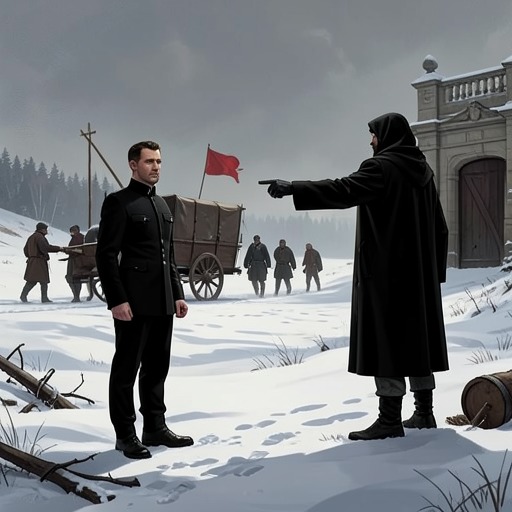
Nate and Louisa have survived a dangerous river crossing, and the covered wagon bears the waterline that confirms their account. Their provisions were lost in the flood, and they have not eaten for days. Once the family reaches dry ground, they smell Molly’s cooking and approach her shanty, where she waits on the verandah with her Cowles & Dunn shotgun at her side. Her four children watch from inside through gaps in the wooden walls.
Molly is accustomed to visitors being potential foes, not friends. She and her children keep to themselves, following the guarded rule she associates with her father: “No one’s business but ours; we are all the family we need.” With only two bullets left, she has reason to measure the strangers rather than welcome them. She notes that the Clintoffs appear to be city people without guns, and that Louisa’s presence, Nate’s injury, and the family’s travel-worn condition may make them less dangerous. These observations do not erase her suspicion; they give her grounds to keep listening.
A Negotiation at the Woodheap
When the travelers reach the woodheap, Nate calls hello. Molly raises her gun and demands that they state their business. Nate identifies himself as Sergeant Nate Clintoff, introduces Louisa and Samuel, and admits that the smell of Molly’s roast has drawn them over. His bluntness embarrasses Louisa, who apologizes for him and explains that they have been traveling for nine and a half weeks, from London by way of Melbourne, and lost their food in the river crossing.
Louisa asks whether the family may share a meal, offering to take a single plate and not intrude at Molly’s table. Nate’s remark that they can see Molly does not have much makes matters worse: Molly responds defensively that her family manages. The exchange reveals the tension between need and dignity. The Clintoffs are genuinely hungry, but Molly is not obliged to treat their hardship as a claim on her household. She holds the conversation on her own terms, taking time before asking whether they are bound for Everton. Their confirmation gives her a practical reason to consider letting them in, without making her caution disappear.
The Children Change the Encounter
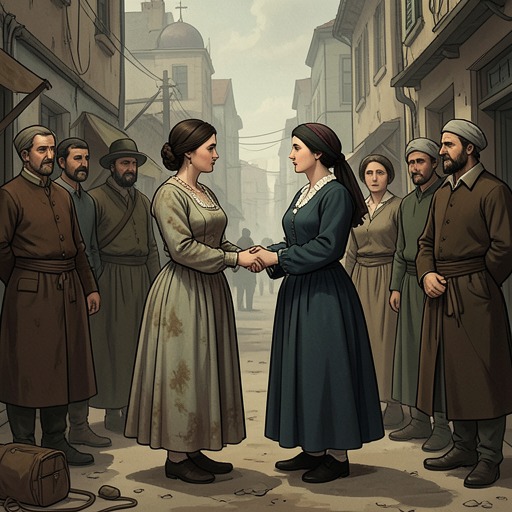
While the adults negotiate, Samuel reaches the verandah and pokes at a hole and the gaps between the wooden slats. Laughter comes from inside. He tries again, and Molly’s four children rush out to join him. Samuel is delighted, and Louisa responds warmly to the children, telling Molly how blessed she is. In the presence of the children, the strangers are no longer only hungry travelers at the edge of Molly’s property: they have become a family her children are already meeting on their own terms.
Molly squares her shoulders and smiles for the first time in the encounter. She motions the Clintoffs inside, ending the standoff with an act of hospitality that remains her choice. The shift is small but consequential: a household organized around privacy and watchfulness makes room for another family after the travelers’ need has been established and the children have crossed the boundary between them.
An Encounter Reframed by Later Events
The meeting takes place within a wider world of hardship and unequal power. The economic depression has struck the sheep industry, tightening household resources and threatening work connected to droving. The Clintoffs’ journey, Molly’s guarded self-reliance, and their shared reliance on family all take shape amid this material insecurity, though the meeting itself is not a resolution to those pressures.
Later developments make the first visit more precarious in retrospect. Yadaka explains that his only crime is existing while Black, in a region where Aboriginal people face arrest, displacement, and the threat of being shot. Nate’s station plans for Molly to be checked on, but the check may be delayed by two days, exposing the limits of official concern for her welfare. Later still, Miss Shirley labels Molly’s children as mixed-heritage children in need of removal, and a judge authorizes their removal. Those events do not change what happens at the shanty: the Clintoffs arrive as flood-stranded travelers, Molly tests their account, and she lets them in. They do show how a moment of chosen hospitality sits beside systems capable of treating Molly’s family not as a household to respect, but as a problem to manage.